
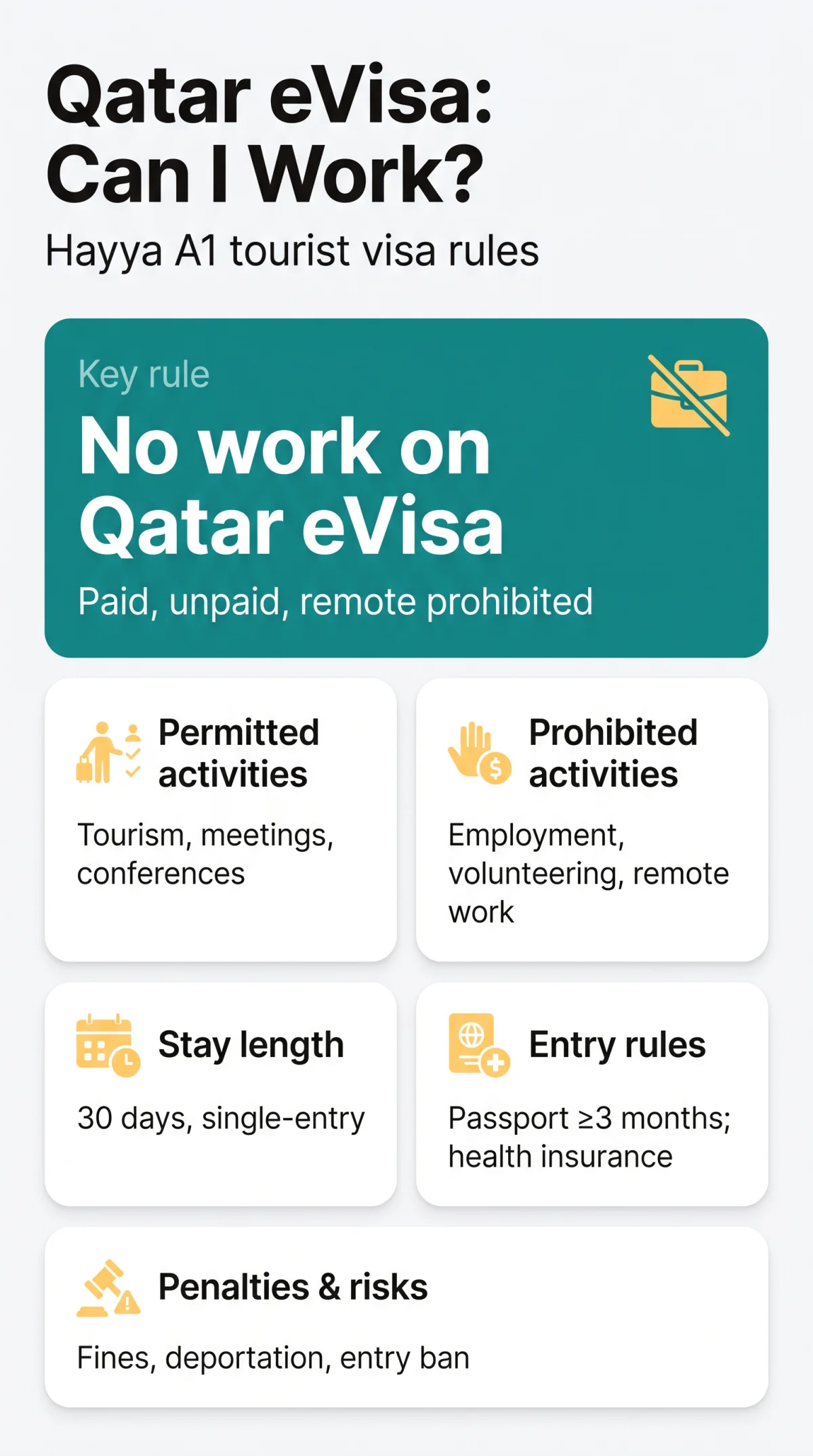
No, you cannot work on a Qatar eVisa. The Hayya A1 tourist visa permits only tourism, leisure, and short business meetings. Paid employment, volunteering, and remote work are strictly prohibited. To work in Qatar, you need a separate work visa with a local sponsor and a residence permit issued by the Ministry of Interior.
Last updated: 14 September 2026. Reviewed by our editorial team specialising in GCC visa policies. This article is for informational purposes only. Visa rules are subject to change without notice per the Ministry of Interior.
Can I Work on a Qatar eVisa? Overview and Restrictions
Work on a Qatar eVisa is strictly prohibited, including remote work, freelancing, and unpaid volunteering. Violating this rule carries fines and deportation enforced by the Ministry of Interior.
The Qatar eVisa is managed through the Hayya platform at, which issues four entry permit types: A1 (Tourist Visa), A2 (GCC Resident Visa), A3 (Visa with ETA), and A4 (Companion of GCC Citizen). The A1 tourist visa grants a 30-day single-entry stay for tourism and leisure only, with processing taking 3 to 5 business days. Apply at least 2 weeks before departure.
Under Qatari immigration law, the Qatar eVisa prohibits all forms of employment: full-time, part-time, freelance, and remote work for any employer. Qatar offers no digital nomad visa in 2026. British passport holders are subject to the same restrictions as all other nationalities.
Entry requirements include a passport valid for at least 3 months from arrival (official MOI requirement), though 6 months is recommended to satisfy airline boarding rules. Compulsory health insurance from companies registered with the Ministry of Public Health is also required.
Can I Study on a Qatar eVisa? Education Restrictions Explained
Formal education on a Qatar eVisa is not permitted. Students must apply for a dedicated student visa through the Ministry of Interior.

The Qatar eVisa (A1) excludes accredited academic activity. Short recreational workshops may be tolerated, but any structured programme requires a separate visa.
| Activity | Allowed on Qatar eVisa? |
|---|---|
| Short recreational workshop | Yes |
| Accredited course | No |
| Degree programme | No |
| Unpaid internship | No |
Apply for a student visa via the MOI portal before travelling.
Permitted Activities on a Qatar eVisa: Business Meetings, Conferences, and Tourism
Attending business meetings, conferences, and trade fairs on a Qatar eVisa is permitted. Performing paid services or consulting work is not allowed.
Permitted activities on a Qatar eVisa include tourism, sightseeing, family visits, attending conferences, trade fairs, and short recreational courses. Business meetings on a Qatar eVisa are allowed, including negotiations and partner visits.
| Activity | Allowed on Qatar eVisa? |
|---|---|
| Business meetings, networking | Yes |
| Conferences, trade fairs | Yes |
| Paid consulting, contract delivery | No |
| Converting eVisa to work permit in-country | No |
You cannot perform paid services, execute contracts as a service provider, or engage in consulting work on a Qatar eVisa.
Volunteering and Remote Work on a Qatar eVisa: Restrictions and Risks
Volunteering, unpaid internships, and remote work for a foreign employer are all prohibited on a Qatar eVisa. Qatari law treats any form of work, paid or unpaid, as employment requiring a permit.
Volunteering on a Qatar eVisa is restricted because Qatari immigration law defines “work” to include unpaid activity. Remote work on a Qatar eVisa is illegal even for a foreign employer with no Qatari clients. Unlike the UAE or Estonia, which offer digital nomad visa programmes, Qatar has no equivalent in 2026.
Unpaid internships are also classified as employment. Even international events in Qatar, such as the Formula 1 Grand Prix on 27 to 29 November 2026 at Lusail International Circuit or IRONMAN 70.3 Doha at Old Doha Port, require proper work accreditation, not a tourist eVisa.
Penalties for Violating Qatar eVisa Terms, Visa Conversion, and eVisa vs Work Permit
Unauthorised work on a Qatar eVisa can result in fines, deportation, and a multi-year entry ban. You cannot convert a tourist eVisa to a work permit in-country.
Penalties enforced by the Ministry of Interior include fines for visa violations, deportation for unauthorised employment, multi-year re-entry bans, and an exit permit requirement: unpaid fines may result in denial of permission to leave Qatar.
Leave Qatar
You must leave Qatar before applying for a work visa.
Employer applies for work visa
Sponsoring employer applies through the Ministry of Labor. Processing takes up to 60 days.
Re-enter Qatar
After the work visa is approved, re-enter Qatar with the valid work visa.
Residence permit application
Employer must file a residence permit application within 7 days of arrival.
Medical examination
Testing for Hepatitis and other transmissible diseases.
Biometric data collection
Fingerprint and biometric data collection by the Criminal Evidence and Information Department.
| Feature | Qatar eVisa (Hayya A1) | Qatar Work Permit |
|---|---|---|
| Purpose | Tourism and leisure | Employment |
| Duration | 30 days | 180 days |
| Entry type | Single-entry | Multiple-entry |
| Employment rights | None | Sponsor company only |
| Sponsor required | No | Yes (employer) |
| Medical exam | No | Yes |
| Residence permit | No | Yes, within 7 days |
| Processing time | 3 to 5 business days | Up to 60 days |
Visa rules are subject to change without notice. Verify current conditions on the MOI portal, published 05 January 2026. For binding legal advice, contact the Embassy of the State of Qatar in London at [email protected] or 020 7493 2200, South Audley Street, W1K 1NB, London, UK.
Frequently Asked Questions: Qatar eVisa Work and Activity Restrictions
Can I work on a Qatar eVisa?
No. Paid employment is strictly prohibited on a Qatar eVisa (Hayya A1). You need a separate work visa with a local sponsor and a residence permit.
What activities are permitted on a Qatar eVisa?
Tourism, leisure, sightseeing, family visits, short business meetings, conferences, trade fairs, and short recreational courses. Anything constituting employment is not allowed.
Can I attend business meetings on a Qatar eVisa?
Yes. Attending meetings, conferences, and trade fairs is allowed. Performing paid services or signing contracts as a service provider is not permitted.
Can I study on a Qatar eVisa?
No. Formal education requires a student visa. Short recreational courses may be tolerated, but accredited or degree-related study requires a separate visa via the Ministry of Interior.
Is volunteering allowed on a Qatar eVisa?
No. Volunteering and unpaid internships are treated as work under Qatari law and require a valid work permit, even though no salary is paid.
What are the penalties for violating Qatar eVisa terms?
Penalties include fines, deportation, and entry bans. Unpaid fines may also result in denial of permission to leave Qatar at departure.
Can I convert a Qatar tourist visa to a work permit?
No. You must leave Qatar and apply for a work visa through a sponsoring employer. In-country conversion from a tourist eVisa to a work permit is not standard practice.
How long can I stay in Qatar on an eVisa?
The Qatar eVisa (Hayya A1) allows a stay of up to 30 days as a single-entry visa. Check the Hayya platform for your specific visa conditions.
Can UK citizens work in Qatar on a visit visa?
No. UK citizens are subject to the same restrictions as all eVisa holders. Employment requires a work visa with a local Qatari sponsor.
Can I do unpaid internships on a Qatar eVisa?
No. Unpaid internships are considered employment under Qatari law. Any form of work, paid or unpaid, requires a valid work permit and residence permit.