
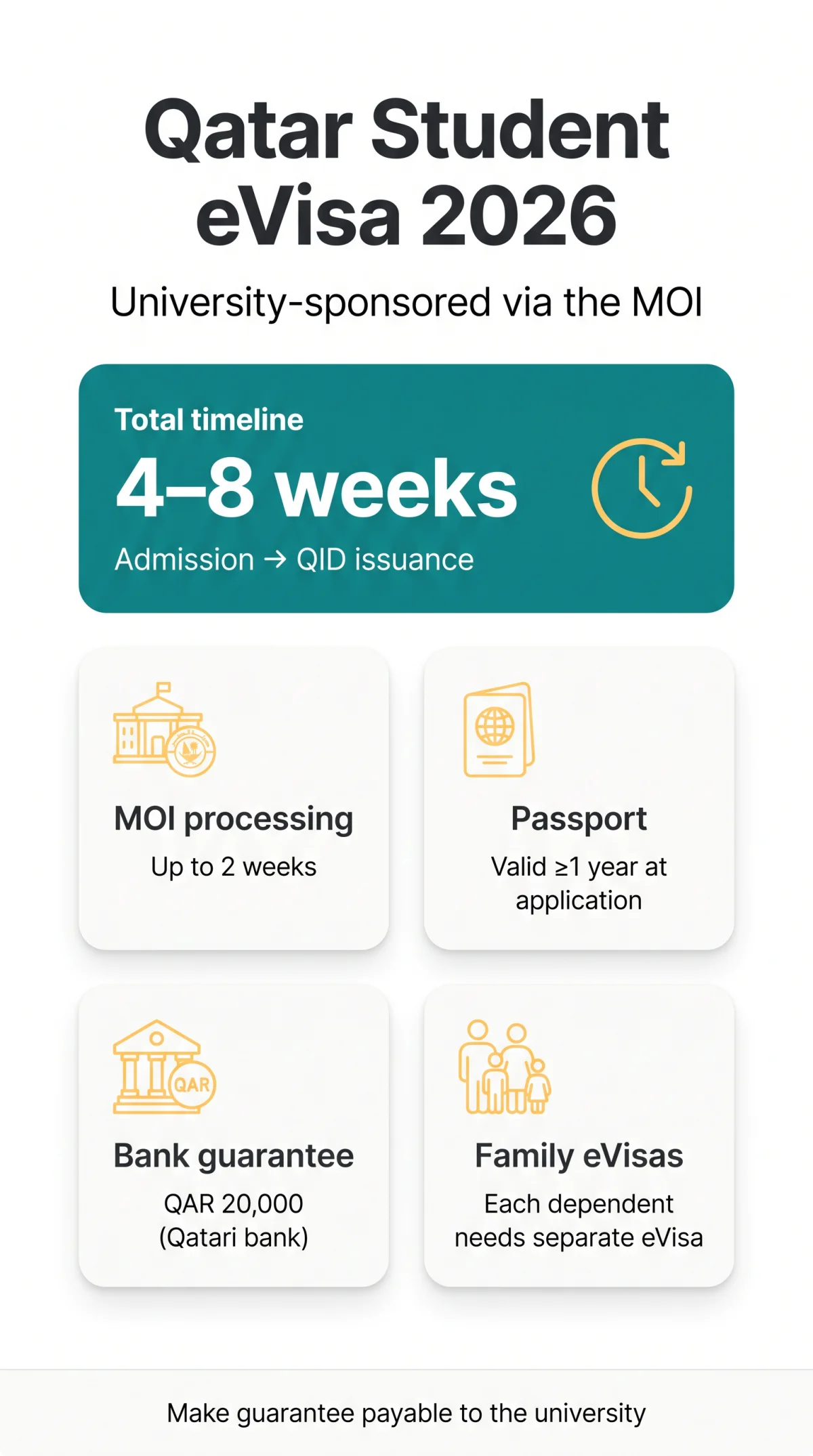
The Qatar eVisa for students requires university sponsorship via the Ministry of Interior (MOI), not a tourist eVisa. Applicants need a passport valid for one year, a QAR 20,000 bank guarantee, and a police clearance certificate. Biometric enrollment occurs upon arrival, with no mandatory interview.
Students cannot self-sponsor. The Qatari educational institution must apply on the student’s behalf after admission. Processing through the MOI takes up to two weeks, with a total timeline of four to eight weeks from admission to Qatar ID (QID) issuance. Tourist eVisas via the Hayya platform do not permit formal academic enrollment.
Family members, including seniors, minors, and infants, require individual eVisa applications. Postgraduate students may sponsor dependents, subject to MOI regulations.
Qatar Entry Options and Student eVisa Process
The Qatar student eVisa is university-sponsored via the Ministry of Interior, not the tourist platform.
- Visa-free entry: Qatar grants visa-free access to 102 nationalities, while 95+ countries qualify for visa on arrival. Neither route permits formal academic enrollment.
- Tourist Hayya eVisa: Available via for short visits only. Fee QAR 100, processing 1 to 3 business days, passport validity at least 3 months from arrival. The Qatar eVisa for students cannot be obtained through this platform.
- GCC Residents Visa: Up to 60-day stay, multiple entries. Conditional eligible countries (marked with *) require a valid US/UK/Schengen visa used at least once, OR a GCC residence visa effective 3+ months, OR permanent residence in US/UK/EU.
Student visa route: The sponsoring university manages the full process through the MOI after admission:
University admission
Passport validity must be at least 1 year at time of application.
MOI application
The sponsoring university submits the application to the MOI (portal.moi.gov.qa) after admission.
MOI processing
Processing takes up to 2 weeks.
Biometric enrollment
Fingerprinting and iris scanning at CEID centres upon arrival.
Medical screening
Post-arrival medical screening before the residence permit is issued.
QID registration
Total timeline 4 to 8 weeks from admission to QID issuance.
Required Documents and Financial Proof for Students
The Qatar eVisa for students requires a passport valid for at least one year, a university acceptance letter, a health evaluation form, and a police clearance certificate issued by authorities in the applicant’s country of residence.
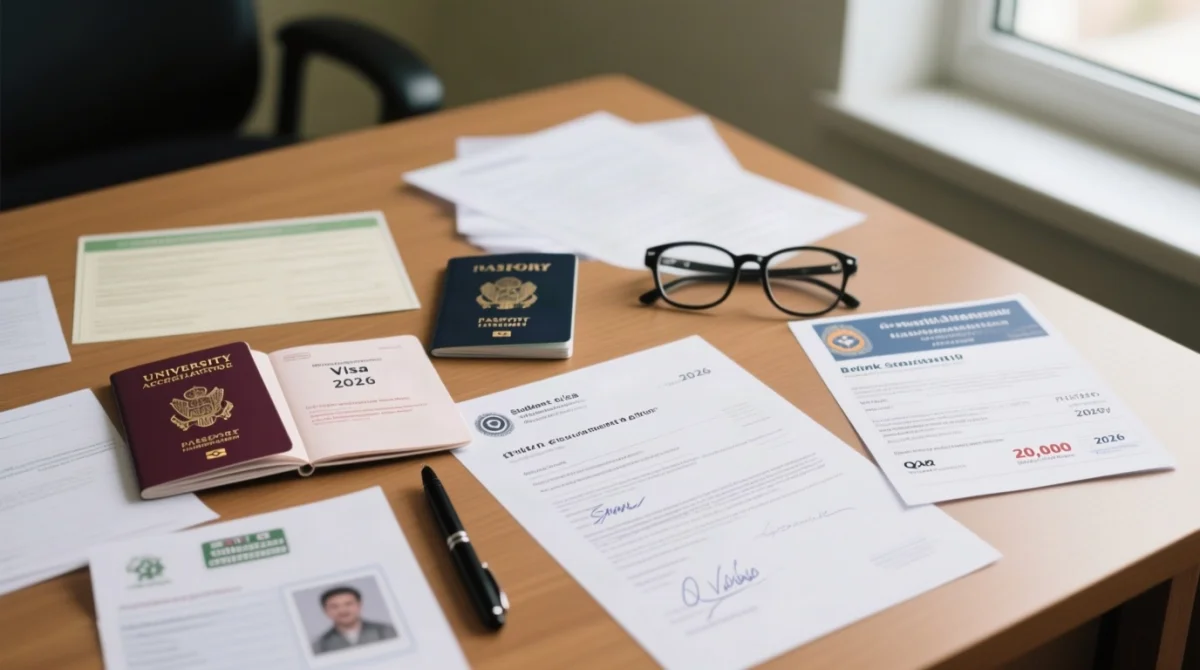
- Passport – minimum 1-year validity at application; must remain valid at least 6 months beyond completion of studies.
- Financial sponsorship declaration – self-sponsorship is NOT allowed; a third-party sponsor must provide a copy of their passport or Qatar ID.
- Bank guarantee – QAR 20,000 (approximately USD 5,470 at 1 USD = 3.64 QAR) issued by a local Qatar bank if the sponsor resides in Qatar; beneficiary is the sponsoring institution. Validity: 5 years (undergraduate/PhD), 3 years (Masters), 1 year (ANNS).
- Bank account statement – required if the sponsor lives outside Qatar; must cover 6 months prior to submission; accepted in English or Arabic only.
- Health insurance – compulsory; must be with companies registered with Qatar’s Ministry of Public Health.
- Police clearance certificate – attestation chain required: obtain from local authorities, authenticate via home country’s foreign ministry, then attest at the Qatari embassy or confirm Hague Apostille.
- Health evaluation form – signed by a medical physician and stamped by a clinic or hospital in the student’s country of residence.
Expert tip: The QAR 20,000 bank guarantee must be issued by a Qatari bank and made payable to the university, not to the student. A standard letter from a UK bank is not accepted. Work with your university’s finance office to set up this guarantee.
The Qatar eVisa for students also requires a passport-sized digital photograph with a white background (maximum file size 2 MB) and a completed student declaration form. Qatar University reserves the right to request additional documents based on individual status.
Biometric, Interview & Language Requirements
For the Qatar student eVisa, biometric enrollment (fingerprinting and iris scanning) occurs at Hamad International Airport (DOH) or CEID centres upon arrival, with no mandatory in-person interview for student applicants.
No consular interview is required for most student visa applicants. The digital university-to-MOI process replaces it, though MOI may request extra documents.
Biometric data submission forms part of the mandatory steps to convert an entry visa into a student residence permit (QID). Both categories of long-term residents must complete biometric enrollment.
IELTS/TOEFL are university admission requirements, not an MOI immigration mandate for the Qatar eVisa for students. All supporting documents submitted to MOI must be in English or Arabic only. Non-English or non-Arabic documents must be officially translated.
Post-arrival medical screening at the Medical Commission in Doha is mandatory before QID issuance. The screening includes a chest X-ray for tuberculosis, blood tests for HIV, Hepatitis B, and Hepatitis C. If a test is flagged, further examination is required and visa cancellation is possible.
Family eVisa Rules: Seniors, Minors & Infants
The Qatar eVisa for students requires each family member to submit a separate application.
Group submissions are not allowed. Each dependent needs an individual passport and separate eVisa; parental endorsements are invalid at Qatari ports of entry.
Seniors aged 60 and over face no maximum age restriction for entry. They must carry compulsory health insurance from a provider registered with Qatar’s Ministry of Public Health and present confirmed accommodation proof on arrival.
Minors under 18 travelling as undergraduate students require a parent or guardian consent letter for university enrollment and residence permit sponsorship. Applications are submitted by the parent or guardian on the minor’s behalf. Unaccompanied minors receive priority processing at Hamad International Airport.
Infants must also hold individual passports and separate eVisas. No age exemption applies to passport validity requirements.
The Qatar eVisa for students permits postgraduate students (Masters, PhD) to sponsor a spouse or children, subject to MOI regulations. Undergraduate students typically cannot sponsor dependents.
FAQ: Qatar Student eVisa Requirements 2026
What are the Qatar eVisa requirements for students from the UK in 2026?
Applicants need a passport valid for at least one year, a university acceptance letter, a financial sponsorship declaration, a QAR 20,000 bank guarantee, a police clearance certificate, and a health evaluation form. Students cannot self-sponsor; the Qatari institution applies via the MOI. Health insurance registered with the Ministry of Public Health is also mandatory.
Do I need a separate eVisa for each family member travelling to Qatar?
Yes. Each family member, including seniors, minors, and infants, requires an individual eVisa application and their own passport. Family members apply through standard tourist channels such as the Hayya platform.
Is a biometric appointment required for a Qatar student eVisa?
Yes. Biometric enrollment (fingerprinting and iris scanning) occurs upon arrival at Hamad International Airport or at CEID centres as part of QID registration. This step is mandatory for converting the entry visa into a student residence permit.
Is an interview required for a Qatar student eVisa?
No. The digital university-to-MOI sponsorship process replaces the consular interview for most applicants. MOI may request additional documentation in individual cases.
Do I need IELTS or TOEFL scores for a Qatar student eVisa?
No. IELTS or TOEFL scores are academic admission criteria set by the sponsoring university, not MOI immigration requirements. All supporting documents submitted to MOI must be in English or Arabic.
How long does it take to process a Qatar student eVisa?
MOI processing takes up to two weeks. The total process from admission to QID issuance takes four to eight weeks, including post-arrival medical screening and biometric enrollment.
Can a minor apply for a Qatar eVisa without a parent?
A parent or guardian must submit the visa application on behalf of the minor. Parental consent letters are required for minors travelling without both parents. Unaccompanied minors receive priority processing at Hamad International Airport.
What happens if I overstay my Qatar student eVisa?
Overstaying incurs a fine of QAR 200 per day (approximately USD 55). Unpaid fines prevent departure from Qatar. Fines can be paid at the MOI office at Hamad International Airport. Overstaying may also result in entry bans for future visits.
This guide was last updated on 14 September 2026. Visa rules change frequently; always verify current requirements on the MOI Qatar website. This is an informational guide, not legal advice.